Saturday, April 2, 2016

Academic Award Dedicated to the Academics for Peace Disturbed the Member of the Turkish Council of Higher Education


Erol Akçay, Assistant Professor of Biology. Photo from Evrensel.


On 2 April 2016, Turkish American Scientists & Scholars Association (TASSA) awarded Erol Akçay, Assistant Professor of Biology at the University of Pennsylvania, the first prize of "TASSA Young Scholar Awards." The award was given during the annual TASSA Conference. The theme of this year is "Science and Society" and the guests included Fikri Işık, Minister of Science, Industry and Technology of Turkey, as well as Abdullah Çavuşoğlu, member of the Turkish Council of Higher Education (YÖK).

YÖK is originally founded by the military government in an attempt to control, regulate and end the autonomy of universities after the 1980 military coup. As a recent letter by the Middle East Studies Association has noted, rather than curtailing YÖK's power, the civilian government of AKP has increased its powers and further enabled its tight grip over the higher education. More recently, YÖK has also been instrumental in pressurizing universities to open investigations against the signatories of the Peace Petition.

At the TASSA ceremony, Erol Akçay dedicated his award to those academics who are imprisoned and whose academic positions have been suspended or terminated. According to the news report by Evrensel, this dedication disturbed the YÖK member Abdullah Çavuşoğlu who was present in the TASSA Conference at the University of Chicago. Çavuşoğlu reportedly asked Erol Akçay whether it is customary in the U.S. to dedicate academic awards to those "who support terrorists." Erol Akçay replied that the incarcerated academics are not in prison because they support terrorists, but because they asked for peace. "They are in prison for having exercised their freedom freedom of expression," he asserted.

In addition to Esra Mungan, Kıvanç Ersoy, and Muzaffer Kaya who were arrested and sent to prison on March 15th, academic Meral Camcı was also imprisoned following her return to Turkey on March 31st.

Serpil Sancar, Dean of the Faculty of Political Sciences at Ankara University: Police has Provocative Attitude on Campus, 19 Students Taken into Custody

Police at the Ankara University Campus
News from BIANET on April 1st, 2016:

Dean of Faculty of Political Sciences (SBF) at Ankara University, Prof. Dr. Serpil Sancar has made a statement as to the police violence and detention of 19 students that occurred yesterday (March 31).
Sancar calling students via Mülkiye Haber (Mülkiye News) has expressed that students acted carefully to not allow any tension by acting responsibly despite police’s provocative attitude.
Sancar highlighting that police used gas unrestrainedly has called SBF Academic Council for meeting today at 3 p.m.
Sancar’s statement is briefly as follows:

“They threw gas even though I said I was dean”

“Today, on March 31 Thursday, as midterm exams are going on at the SBF, Riot Squad entering the campus to prevent the fight erupted among students, acted in a provocative way against students without a reason or problem by breaking into the SBF a couple of times.
“Later on, they forced the students at the Faculty garden to enter the building, batter the academics trying to come between them, and fired gas cartridge to where I stood even though I said I was dean. A large number of personnel, students, and lecturers (including me) have been disturbed because of this.
“During these incidents, the students haven’t reacted negatively by acting circumspectly and that behaved responsibly to not prepare an environment of tension with the police”.

Gas capsule at the academic hall

“One of the gas cartridges got into one of our lecturers’ pocket and the lecturer entered Academic Meeting hall without realizing it to follow the conference.
“A while later, the gas cartridge exploding in the conference hall caused a huge panic”.

“Police have been hindering education for a few weeks”

“Education has been suspended for a day since it is impossible to make midterm exams within the issues in subject.
“Riot Squad entering the campus in order to intervene in the banners hung on the wall have been apart from this reason behaving badly against students and lecturers who were unaware of the incident in the faculty building for a few weeks, and causing chaos to an extent to hinder the education.
“Under these circumstance, I am calling SBF Academic Council for meeting today at 3 p.m.” (EKN/TK)

The SBF Academic Council has met, and decided to support the Faculty of Political Sciences. You can reach their decision statement from here.

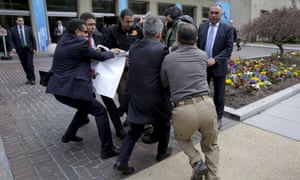
Erdoğan's security guards act like they are in Turkey during his visit to the US

Turkish security struggle to take a sign away from protesters in front of the Brookings Institute.
Photograph: Joshua Roberts/Reuters        

Erdoğan's security guards attacked journalists and protesters on the streets of Washington, DC, right before he was about to arrive at the Brookings Institution. According to Foreign Policy, "Brookings President Strobe Talbott told a Turkish official that the organization was prepared to call off the visit even though Erdogan’s motorcade was already en route to the event." The Brookings Institution acknowledged the "harassment on the part of Turkish security personnel." As reported by the Guardian, Amberin Zaman, a public policy scholar at the Wilson Center and former Economist correspondent in Turkey, stated that "This is not unusual behavior for his security detail. They act with impunity and there is no evidence they are reprimanded for it. I would like to think we’re safe in the United States but we’re not. We’re vulnerable to bullying by Mr Erdoğan’s security detail even in the capital.”

Friday, April 1, 2016

Dr. Meral Camcı's Letter - written one day before she returned to Turkey


An arrest warrant was issued for Drs. Esra Mungan, Kıvanç Ersoy, Muzaffer Kaya and Meral Camcı for a Press Release they read on March 10, 2016 on behalf of Academics for Peace. Drs. Mungan, Ersoy and Kaya were arrested on March 15. Dr. Camcı was in vacation in France at the time of their arrest, she returned to Istanbul on March 30 and was arrested the next day. The following is the letter she sent to her friends the day before her return trip.

Hello Dear Friends, 

Yes, I’m coming back tomorrow. I’m returning from a trip that I had started not to stay away but to come back in the first place. Soon after our press conference, I had come to Paris for a short time to visit my child who is studying here for the last four years. Three days after I arrived here, I learned that they came to my house with an arrest warrant. Even though I was not with them, I lived through from a distance the process of our friends’ detention and arrest both in my mind and in my heart just as you did. It never occurred to me to stay abroad or extend my trip. Following the advice of our dear and valued lawyers, I waited for the result of our first plea to the court for an annulment of this unlawful arrest and for the possibility of our friends’ rightful release. This process was completed yesterday when the court rejected our plea and I booked my return flight: I’ll land Yesilkoy Airport on Wednesday, March 30 at 2.20 pm.

I am writing this statement with a sense of morale and value that our togetherness and solidarity inspires in me. My decision to return is of course taken voluntarily and in all sincerity. From my perspective, this is a decision based on a foregone conclusion. Just as it was inevitable that I signed the [peace] petition and later the press statement. This is as certain as my belief in a country that lives in peace, equality, together in all its differences, and in a democratic country without any buts or ifs. I see the struggle for peace as a process. We are but in one moment of this process – a process that has a past as well as a future.

Against all odds I have not lost hope in this country; we wanted peace and we will stand by our words come what may. We will expose the universities that trample [academics'] rights and we have promised we will transform the universities as well as change this country… This is a debt I feel I have towards the youth, to children and to my students whom I was forced to leave. If this is the price they say we should pay, we will do that with honour and peace of mind because we are in the right. If they jail us, so be it, we will defend ourselves from jail holding our heads high, then we will be released and we will continue in our path.

We will carry this burden in our hearts together my friends … just as we wrote with a friend in our private correspondance. Unless we do not free our minds, it does not matter which side of the wall we are sitting. We will break down those walls and then we will be free. And we will do that by working both from the inside and the outside. Now, it is time for me to be there. All of you are of course familiar with Socrates’s defense. He says “exile is the greatest punishment that can be given to any man,” and I cannot live a life that I have not chosen of my own free will. Because in that case I will not be me. I will stand by my words for peace and I will continue the struggle.

This is the only way for me to be human since last June and to continue being human. This is also the only way I can continue my scientific work, research and production.

With love and in solidarity,

AAUP Statement Protests Turkish Supression of Academic Freedom

The following statement signed by American Association of University Professors (AAUP) President Rudy Fichtenbaum and First Vice-President Henry Reichman was released on March 30, 2016:

The American Association of University Professors does not normally take positions on alleged violations of or threats to academic freedom outside the United States, both because we are hesitant to impose our standards on others, whose histories and situations may differ, and because we are usually incapable of conducting in other countries the kind of thorough investigations we require to place American institutions on our censure list.

But the current situation in Turkey, where most recently three scholars have been jailed and a British scholar deported for allegedly “making terrorist propaganda,” cannot pass without protest. The arrests and deportation were but the latest actions taken against 1,128 Turkish professors who in January signed an Academics for Peace petition calling for an end to the military campaign against Kurdish separatists in southeastern Turkey. More than a thousand additional academics have signed the appeal since then. Scholars who signed were accused by president Recep Tayyip Erdoğan of “treason” and have suffered an array of repercussions, including criminal investigations and university-level disciplinary proceedings. According to reports, almost 800 academics who signed the letter have faced action either by their university, state authorities, or both. Thirty-eight have been dismissed, 29 suspended and 531 face an administrative investigation. Other faculty members who signed the petition have been denounced and threatened on social media. Some have received intimidating visits in their campus offices by groups of nationalist students.

A total of 1,406 academics from 62 countries have now signed a further letter calling on the international community to urge Turkey’s government to “stop the witch-hunt” against dissident academics, “respect academic freedom, free the arrested academics, and reinstate all the academics suspended or expelled during the persecution campaign with compensation.”

The arrests of the three academics came a day after President Erdoğan called for a broadening of the definition of terrorism. He said there was no difference between “a terrorist holding a gun or a bomb and those who use their position and pen to serve the aims” of terrorists. Erdoğan added that this could be a journalist, a lawmaker or an activist. According to many observers, the crackdown on academics is part of a wider effort by President Erdoğan to stifle criticism of government policies and restrict liberties in the country. A number of journalists have been imprisoned in recent months, and earlier in March the government seized the offices of an opposition newspaper, Zaman, the second largest newspaper in the country.

Now the government has reportedly drafted a new bill to suppress academic freedom. According to the draft bill, any professors involved with “activities that have separatist claims or terror activities, or acts in support of this” may be dismissed from their positions and lose public offices. Under the proposal, the state higher education authority may move against scholars for “crimes” of political and ideological petition; propagating for political parties; and discrimination based on language, race, color, gender, political thoughts, philosophical belief, religion and sect.

In January, US ambassador to Turkey John Bass issued this statement:

We are seeing reports of academics being investigated and subjected to penalties for expressing their opinions about the conflict in the southeast. While we may not agree with the opinions expressed by those academics, we are nevertheless concerned about this pressure having a chilling effect on legitimate political discourse across Turkish society regarding the sources of and solutions to the ongoing violence. In democratic societies it is imperative that citizens have the opportunity to express their views, even controversial or unpopular ones.

Expressions of concern about violence do not equal support for terrorism. Criticism of government does not equal treason. Turkish democracy is strong enough and resilient enough to embrace free expression of uncomfortable ideas.

We applaud the ambassador’s statement and share his concern, which can only be intensified by the subsequent developments described above. Until recently Turkey had a reputation for leaving scholars alone to pursue their interests, at least relative to its neighbors. Many Arab students and even faculty members have moved to Turkish institutions in recent years. But the current crackdown could lessen Turkey’s academic appeal. On behalf of the AAUP, we join with our colleagues in the international scholarly community in calling on the Turkish government to stop the witch-hunt against Academics for Peace, respect academic freedom, free the arrested academics, and reinstate all the academics suspended or expelled during the persecution campaign with compensation.

—Rudy Fichtenbaum, President, American Association of University Professors
—Henry Reichman, First Vice-President and Chair, Committee A on Academic Freedom and Tenure, American Association of University Professors

The New York Review of Books - Turkey's Attack on Teachers


The Letter to be published in the April 21, 2016 issue of the New York Review of Books:

by Kwame Anthony Appiah, Seyla Benhabib, Judith Butler, Drucilla Cornell, and Jan-Werner Müller, et al.

To the Editors:

We write to express our dismay at the deterioration of freedoms of expression, association, and personal security faced by our colleagues in Turkish universities and the media.

University professors Esra Mungan, Muzaffer Kaya, and Kıvanç Ersoy were arrested on charges of spreading “terrorist propaganda” because they signed a petition condemning the Turkish government’s security operations in cities of the southeast, owing to the disastrous impact on the Kurdish civilian population. Made public at an Istanbul news conference on January 11, the petition also called for a resumption of peace talks with the PKK.

For signing the petition, at least thirty-eight academics have been dismissed and twenty-nine suspended by their universities. An Istanbul prosecutor is investigating all academics who signed the petition. Those who have been arrested could face up to five years’ imprisonment.

While we forcefully condemn the suicide bombings of civilians that have recently plagued Turkey, we insist that it is unwise to silence any critique of the government’s dealings with its Kurdish population when the general security situation in the country is deteriorating.

Before the Gezi Park protests of 2013, the ruling AK Party had initiated a peace process with Kurds, and Turkey had an opportunity to become a more pluralist, tolerant, open, and vibrant society. As social scientists and theorists in different fields, we followed these developments closely, but now we observe the near-collapse of a constitutional multiparty democracy and the move toward authoritarian presidentialism, the emergence of government by plebiscites and decrees, the squashing of the opposition, and the silencing of civil society institutions. None of these developments is necessary. Turkey still has strong and exemplary parliamentary, judicial, scientific, and civic institutions that can navigate this period of multiple crises.

We call upon the Turkish government and judicial authorities to suspend all charges against academics who signed the petition, and we ask that individuals who have lost their academic positions be reinstated with due process.

We encourage the AK Party and its representatives to return to the spirit of uzlasma(reconciliation) with Turkey’s Kurdish citizens who are in search of an acceptable resolution to a conflict that is growing all the more dangerous because of the instability on Turkey’s borders and the Middle East region.

Valérie Amiraux, University of Montreal
Talal Asad, CUNY Graduate Center
Anthony Appiah, New York University
Albena Azmanova, University of Kent, Brussels School of International Relations
Zehra Arat, University of Connecticut
Etienne Balibar, Université de Paris-Ouest Nanterre and Kingston University London
Seyla Benhabib, Yale University
Richard Bernstein, New School for Social Research
Darin Barney, McGill University
Claudia Berger, Indiana University
Akeel Bilgrami, Columbia University
Patrick Brantlinger, Indiana University (Emeritus)
Susan Buck-Morss, CUNY Graduate Center
Judith Butler, University of California at Berkeley
Giancarlo Bosetti, Journalist, Italy
Purnima Bose, Indiana University
Wendy Brown, University of California at Berkeley
Claude Calame, Ecole des Hautes Etudes en Sciences Sociales
Robin Celikates, University of Amsterdam
Benoit Challand, New School for Social Research
Gabrielle Coleman, McGill University
Drucilla Cornell, Rutgers University
Alex Demirovic, Goethe-University, Frankfurt
Alessandro Ferrara, University of Rome, Tor Vergata
Didier Fassin, Institute for Advanced Study
Rainer Forst, Goethe-Universitaet, Frankfurt
Josef Früchtl, University of Amsterdam
Nancy Fraser, New School for Social Research
Stefan Gosepath, Freie Universitaet Berlin
Sally Haslanger, MIT
Axel Honneth, University of Frankfurt and Columbia University
Dick Howard, SUNY at Stony Brook (Emeritus)
Engin Isin, The Open University, London
Rahel Jaeggi, Humboldt University Berlin and New School for Social Research
Serhat Karakayali, Humboldt University Berlin
Volker Kaul, University of Rome
Ivan Krastev, Journalist, Sofia and Vienna
Regina Kreide, Justus Liebig University Giessen
Daniel Loick, Frankfurt and New York
Michel Lowy, CNRS Paris (Emeritus)
Oliver Marchart, University of Vienna
Rosalind C. Morris, Columbia University
Jan-Werner Müller, Princeton University
Frederick Neuhouser, Barnard College
Christian Neuhäuser, Technical University Dortmund
Peter Niessen, University of Hamburg
Kalypso Nikoalidis, Oxford University
Anne Querrien, co-editor of journal Multitudes
Bruce Robbins, Columbia University
Hartmut Rosa, Jena University
Juliane Rebentisch, Offenbach University of Art and Design
Benjamin Robinson, Indiana University
Martin Saar, Liepzig University
Guillaume Sibertin-Blanc, Toulouse University
James Sleeper, Yale University, Journalist
Céline Spector, Université Bordeaux Montaigne
Ferdinand Sutterlüty, Goethe University Frankfurt
Judith Revel, Universite de Paris Ouest Nanterre
Beate Roessler, University of Amsterdam
William Scheuerman, Indiana University
Etienne Tassin, Université Paris Diderot
Bert van den Brink, Utrecht University
Eleni Varikas, University of Paris (Emeritus)
Nguyen Vu Thuc Linh, European University Institute
Sophie Wahnich, CNRS, Paris
Michael Walzer, Institute for Advanced Study (Emeritus)
Frieder Otto Wolf, Freie Universität Berlin

Sunday, March 27, 2016

Pro-AKP Media Figures Continue to Target Academics for Peace

PRO-AKP MEDIA FIGURES CONTINUE TO TARGET ACADEMICS FOR PEACE

On 22 March 2016, Yıldıray Oğur, a pro-government media figure, wrote a column targeting the Academics for Peace, Bosphorus/Boğaziçi University, the Middle East Studies Association (MESA), and Jadaliyya, among others. 

The piece problematically conflates terrorism with Academics for Peace, and blatantly asserts that signatory academics manipulate facts. At the same time, the author appears to obscure the fact that after the Suruç bombing on 20 July 2015, the ruling party AKP, together with Turkish nationalist party MHP, blocked a parliamentary investigation on the ISIS-led suicide bombing in Suruç. And in fact, only one month before the Suruç bombing, on 16 June 2015, reporters had asked the AKP-appointed governor of Urfa (where Suruç is located) whether ISIS militants posited a threat in the area. In response, the governor had the reporters taken into custody. The thirty-two youth killed on 20 July 2015 were pro-Kurdish activists who were getting ready to cross the Syrian border to plant trees as a symbolic act for peace and to bring humanitarian aid (toys, food) to Kobane—where Kurds fought against ISIS. Instead of investigating ISIS at length, the government started bombing PKK camps, thus ending the peace process.

Had the government shown the same diligence with the ISIS cell responsible for the Suruç bombing and not blocked a parliamentary investigation, could the bloody Ankara bombing that cost 102 lives in October 2015 be prevented? (The Ankara bombing had targeted a pro-Kurdish peace rally organized by labor unions and professional organizations, including the Turkish Medical Association.) This is a legitimate question, as it turned out the same ISIS cell was responsible for both the Suruç and the Ankara bombings. 

By lumping together all these different bombings that marked Turkey since June 2015 (when another bomb exploded during the pro-Kurdish party HDP electoral rally right before the general elections), the author conveniently erases their differences as though they all have targeted the government. As such, the author appears to attribute them altogether to the government’s perceived enemies, such the Kurds or the Academics for Peace. Further, the author obscures the fact that calling for government accountability doesn’t have the same implication for each and every one of the bombings he cites. The 2015 Suruç and Ankara bombings are examples for this.

In the current Turkish context, where bureaucratic transparency has dramatically eroded, a parliamentary investigation could have meant some sort of transparency; the investigation findings would likely go on the public record. Currently, the public is cut off from the opportunity to even follow any such violent attack (i.e., suicide bombing) in the media, because government officials are quick to issue a public ban on media coverage of the bombings, and to suspend access to some websites and social media. This has been a general trend so far, with some variations in application.

Holding one's government accountable for the escalated violence and the prolonged bans against going out in the street (mistakenly called "curfews"—as they last for months without any possibility of going to search for food, water, or medical aid, including at night) that cost civilian lives in Kurdish regions would be a predictable outcome in a democratic country. In a democracy, the government would be accountable for and to its citizens, and the citizens would have the right to critique the government's policies and demand transparency. But to pro-government media figures, exercising the right to freedom of expression and assembly appears to be a sign of propagandizing terrorism. It is indeed important to remember that this is what the court record finds the three imprisoned academics guilty of: that they signed a petition which only criticized their own government,and not the PKK.

One thing is certain: the advocacy of conspiracy theories and the criminalization of a petition are in fact the criminalization of the right to expression and assembly, and amount to a practice of thought policing.

Further, in the below piece, Yıldıray Oğur disingenuously insinuates that MESA's letters are the result of a conspiracy, dismissing the fact that MESA in itself has members who study Turkey or other countries in the Middle East, and who are perfectly capable of reading, listening and judging the situation for themselves. In addition, in an environment where academics are placed in high-security prisons, strip-searched, and put in solitary confinement simply for having signed a petition and for having called for peace, such professional support is a demand for justice for one's colleagues, and not evidence of a conspiracy.

The readers might ask why we give such space to a clearly polemical newspaper column. Unfortunately, it is because such conspiracy theory articles might be considered as grounds for prosecution in Turkey. Indeed, as we have already mentioned in an earlier post, a similarly conspiratorial and problematic article was accepted as a criminal complaint by the Istanbul Chief Prosecutor's Office, which eventually led to the arrest warrant for the three academics who are now in prison and placed under solitary confinement. 
The English translation of the piece is below.
******************************
Simons[1] Living in Bosphorus -2-
22 March 2016
Yıldıray Ogur

There was a fire set in the Kartal Aydos Forests on 25 August 2015. Tuzla Infantry School was also located there. It was difficult to extinguish the fire. The police started to inquire about the possibility that the fires were acts of sabotage when a new forest fire was set on 10 September 2015, fifteen days after the first fire on the same military location.

After some time, a group of PKK members who set this fire organized attacks against general stores and the offices of the Justice and Development Party (AKP).

On the basis of the information acquired from these PKK members, a “carrier,” who carries the PKK’s reports from İstanbul and other regions to Diyarbakır, was spotted. 
The carrier was monitored, and on 7 October 2015 was taken under custody at İstanbul Sabiha Gökçen Airport when he was just about to get on a flight to Diyarbakır. 

The person who was taken under custody was H.D., a senior at Bosphorus University—a university where students are admitted by the higher scores on the central examination for university education. 

H.D., who was a member of the Youth Assembly of the Peoples’ Democratic Congress—an organization run by co-presidents Sabahat Tuncel and Ertuğrul Kürkçü—had not committed any illegal deed until that day. According to the police forces, that is the reason  why he was selected as the carrier. The information that he carried was on a flash memory drive, containing the reports released to the press. The reports were meant to be handed to someone whose address and identity was specified and who was in Diyarbakır and known as the [PKK] Representative in Turkey. 

According to the resources of the police, one of the reports in the same flash memory drive was sent from the PKK’s Çukurova region, in which a woman militant stated that “she is ready even for a suicide bomb attack if needed.” 

Up until now I have listed the claims of the police forces released to the [mass] media, and those that I could access myself. 

Now let’s turn to what H.D.’s attorney said: 
“The police forces invaded H.D’s home and they seized his unbanned books. These books have the record label of the Ministry of Culture on them. Besides that, a couple of journals were also confiscated. Apart from that they also found a couple of songs on his phone and downloaded them. Afterwards they said ‘If you listen to these songs and read these books, then you are a member of the organization’ [meaning the PKK—translator’s note]. They showed the videos that he watched and songs that he listened to, saying that ‘There are members of the organization in these videos,’ thus blaming H.D. for this reason.” 

This is the defense that claims “there is nothing at all,” resembling the defense by the attorneys, examples of which were also listed in my previous piece. It turns out that the police forces took under custody a university student, not in his home or school, but at the airport just on the basis of the songs that he listened to on YouTube, just for oppression. 

Yet, we still have just reasons to be skeptical. In Turkey there is this tradition of unjust custody and quick attribution to membership in the organization. There were a lot of examples of this in the past; today it is still continuing. 

The news was broadcast in certain part of the mass media on the basis of the claims by the police forces; and in another part of the mass media on the basis of the attorney’s declarations. Again, the news concerned was cleared of any doubt. For example: “The Bosphorus University student who was an HDK member, was arrested because of the books he read and the songs he listened to!” But I assume that when we are struggling against terror which locks people in their houses, no one has the luxury to manipulate the truth in accordance with political interests, not at all. Especially in a country where suicide bombers explode themselves all over [the country]; when the PKK started armed “resistance” in Sur, Cizre; when the world is struggling against terror and Turkey is the neighbor of those centers of terror; and moreover when the state is being criticized rightly for failing to preempt the terrorist acts on time, for failing in intelligence regarding suicide bombers, a university, and especially the scholars of the university—which is the best university in Turkey—are expected to be more cautious, more skeptical.

This is all the more so when the students whose responsibilities that they take on themselves are concerned. But no, it could not happen this time either. Partisanship, revolutionary solidarity, unconditional support overwhelmed; and the academics did what the journalists in my previous piece did. Around two hundred academics working at Bosphorus University, including those most prominent in their respective fields, all of whom are typically very wary, signed a declaration, titled “we claim our student.”  This did not suffice. Beth Baron, the chair of the US-based Middle East Studies Association (MESA), one of the most well-known institutions in the field of research on the Middle East, wrote a letter to Prime Minister Davutoğlu on behalf of H.D., clearly based on the reference of the scholars from Bosphorus University.  

(I can presume who facilitated the writing of the letter. However I do not have solid information about it. Thus, let me just put this link here: http://www.jadaliyya.com/pages/about)   While the scholars were writing the aforementioned declaration, H.D.’s attorney, Hüseyin Boğatekin, who is a member of the Association of Libertarian Jurists [Özgürlükçü Hukukçular Derneği], was defending the rights of other students in Balıkesir in another lawsuit. (There is a legal support network formed by Boğatekin and his association, which gives support to the students who are brought to court in PKK-related cases.) One of those students turned out to be a suicide bomber six months later in Ankara. Briefly, the attorney who is the source of all the information about H.D.’s innocence has another client whose name is even mentioned in the letter from the MESA chair to Prime Minister Davutoğlu, and whom the attorney defended on the grounds of similar arguments, exploded herself/himself five months later in the center of Ankara. It is certain that an attorney can defend anybody. S/he cannot be blamed for defending her/his client. But it is essential to keep doubt alive when you’re vouching for some one. This is all the more so when the student you had defended against slander turns out to be the suicide bomber responsible for the death of thirty-seven innocent people.But even this case does not seem to have led to doubt or confusion among the Simons living in Bosphorus. This is still so even when the police forces claimed that one of the reports carried by one of the students contained a woman’s statement of her willingness to be a suicide bomber. And we are talking about a university where two vehicles parked in the parking lots in and out of the campus, were seized with the suspicion that they would be used in a suicide bombing attack, about twenty days ago. Let’s read the news about the seizing of the first vehicle from Hürriyet: “The police forces were following Sinem Oğuz, with the alias Funda Kaya. According to the police forces’ findings, mechanisms were set in the Citroen brand automobile; the explosives that would be carried over from Diyarbakır were yet to come. The automobile was taken to the parking lot in the university by an employee in the Bosphorus University, who is an acquaintance of Sinem Oğuz.The university employee, R.Ü. who helped Oğuz, vanished away. Sinem Oğuz went to Diyarbakır. Oğuz and her accomplice H.A. beside her, both purported PKK members, were arrested in Diyarbakır on 27 January.”When you search on the campus of Bosphorus University for R.Ü., the university employee who “hosted” the vehicle carrying the mechanism for locating the bomb you come across an administrator who is probably in control of the whole information network of the university. According to the police records, the bomber Sinem Oğuz and the person accompanying her went to Diyarbakır to pick up the bombs that would be located inside the vehicle. Then, if they had been able to return [to İstanbul] without being arrested, where was the target of the vehicle, waiting on the campus of Bosphorus University? Again, according to the police records, the target was the mobile striking force spot, just behind Taksim Square. This means Taksim Square! This means all of us! If a state had this much information, and if the state were to say “no way, s/he would not do such things,” and if that man or another person with his assistance had committed an act, that state would have been severely accused and this would have been a just accusation. And what about signing a petition under this responsibility, in the face of a case that makes one horrified even in its one in a billion probability of being true? We are all right to criticize the state, the intelligence, to ask for more precautions regarding suicide bombers, regarding terrorism. Then what about those, who open breathing space and acting space for terrorism and for suicide bombers through their political battles, ideological animosities, revolutionary solidarities, who support them, who open the path to them in their newspapers, in the courts, in the universities; who unconditionally believe in their propaganda; who are used as instruments… 

If we want to protect our liberties and our security none of us has the right to become a Simon, especially now, when a list, citing Suruç, Ankara, Sultanahmet, Ankara, İstiklal, stands before us...NOTES

[1] Here the term “Simons” is most probably used in the way it was used in Hanefi Avcı’s book, titled Haliç’te Yaşayan Simonlar (Simons Living in Haliç), basically denoting those people who totally abide with the priorities and aims of the groups/organizations to which they belong and who react against only those violations of rights that are directly related to their groups/organizations. Besides, the name “Simon” has widely been used in the discourse of conservative circles throughout republican history in Turkey in a rather pejorative manner. It is a kind of a “catchword” that reflects the common conservative discriminatory stance against any ethnicity/religious identity that is not related to Sunni-Muslim Turkishness. Briefly, while the term is originally Hebrew, it is also used to connote Armenian identity.


Support Imprisoned Academics for Peace with the Twitter Campaign Starting on Monday 3/28, at 2pm EST


FREEDOM FOR IMPRISONED ACADEMICS FOR PEACE!

Please support our Twitter campaign #Freedom4Academics4Peace starting on Monday March 28, at 9pm Turkish time [2pm EST] to raise our voice for academics for peace arrested and held in solitary confinement in Turkey.

ACADEMICS FOR PEACE

Saturday, March 26, 2016

Map of Persecuted Academics - and international support


2212 academics who are citizens of Turkey signed the "We will not be a party to this crime" peace initiative of January 11, 2016. These academics are from 105 different universities in Turkey and 328 universities abroad.


According to the latest survey that Academics for Peace (BAK initiative) conducted among its signatories, the breakdown of their persecution is as follows.

 47: Threats by the press, government and students
   7: Forced resignations by the university administrations
  29: Suspended by university administration
532: Admininistrative investigation by the university
  38: Fired by the university
158: Criminal investigation by the public prosecutors
  37: House search and detention by the police
    3: Arrest by the state (under solitary confinement)

On March 25, BAK Iniative issued an Urgent Call for Solidarity in response to the cases of Kıvanç Ersoy, Muzaffer Kaya and Esra Mungan Gürsoy who were placed in solitary confinement. Earlier on March 22, in a letter sent to US Department of State, 143 US-based academics asked the US Government to call on the Turkish government immediately to stop the persecution of Academics for Peace, respect academic freedoms, free the arrested academics (Mungan, Kaya and Ersoy), and reinstate with compensation all the academics suspended or expelled during the persecution campaign.

Thursday, March 24, 2016

Messages and Letters of Arrested Academics - and Interview with Dr. Meral Camci in Science


Message from Drs Ersoy and Kaya’s lawyer who saw them earlier today (March 24): "they are sending their greetings and thanks to everyone. They expressed that they are under very strict solitary confinement, they are kept in two separate rooms, each big enough for three persons, they are not allowed to see each other or other inmates, all of their books are confiscated with the promise of giving them back later, there is nothing in the room except a notebook and a pencil, when they were first transferred to Silivri [Prison yesterday], they were treated with utter disregard for dignity, they were strip searched and forced to wait naked for 20 minutes, their first demand is to be allowed to stay in the same cell."


The statements Drs. Mungan, Ersoy and Kaya gave to CHP [Republican People's Party] Parliamentarians' Prison Inspection Commission who visited them on Monday, March 21

Esra Mungan (Boğaziçi University): “(...) I am staying in solitary confinement under the same conditions as inmates sentenced to heavy life imprisonment. During the interrogation they asked me the 14 questions mentioned in Akşam newspaper [earlier translated by GIT – NA here]. They claimed I received instructions from KCK. A true academic never receives instructions from anyone. This is exactly the reason we are against Higher Education Council [YÖK]. We find it unacceptable to carry out any instructions. That is why we are struggling against YÖK, we want to govern ourselves [as academic institutions] (...) For the first time in my life I spent 50 hours without reading any books. It was psychological torture for me to be left without books. (...) The thing that’s in my mind most is the course-work for my students. I have 54 students. I’m giving a course on Memory. I miss the course I’m giving most. (...) I was able to rest physically but I am greatly disturbed psychologically. I used to go to the university at 8 am and I used to turn off the lights [when I was the last to leave]. What’s important to note is that my students are being deprived of their right to education. I cannot tutor my thesis students, their right to education is taken away. I was teaching a course for 13 Masters’ students. It was fun, now they must feel abandoned. (...) I studied in Germany from age 2.5 until 15. They were constantly teaching about the atrocities of the Nazi period and how awful things were during that period. Through the education I received I learned to be able to ‘say no’ even when the majority of the society says ‘yes’. Everyone was saying ‘yes’ in Hitler Germany but eventually all the wrongs were uncovered. I am reminded of Germany during Hitler period when I think of the present period. Freedom of thought is important, I will never do anything I don’t believe in. I was working on and caring for problems of people from all walks of life; I advocated for the rights of subcontractors and the outsourced jobs at the university.”


Kıvanç Ersoy (Mimar Sinan University): “I’ve heard my students are saying ‘Professor Ersoy would not give even Fail grades how can he be a terrorist?’. Well, we’re here in jail because we demanded peace. We’re here because we read a press statement. In our struggle for democracy Metris Prison is just one transit stop. And sometimes you need to spend more time in some stops. When we witnessed the last explosion we thought maybe this is a safer place to be. (...) And they are accusing us for not making statements against the PKK. Fascism is not the prohibition of speech, it is the obligation to say things (...) We are not in prison for the things we’ve said but for the things we’ve not said. We’re put in jail to please President Erdogan. This is what happens in a country where there is no culture of democracy. They had subpoenaed Charlie Chaplin to testify in the McCarthy era and asked “are you a communist?’ He refused to answer. In his memoirs 30 years later, he wrote: ‘I was not a communist but it was an insult to ask me that, that’s why I refused to answer.’ 


Muzaffer Kaya (Nişantaşı University): “2200 academics signed the petition and they have arrested only us. We did not make the statement on behalf of everyone. The statement was made on behalf of ‘Academics for Peace – Istanbul’. There is no reference to self-government in our statement. I do not regret signing. They have concluded that we are making propaganda for the terrorist organization because we did not criticize and made no mention of PKK and because we criticized the state. The Rector of our University supported us but since then he resigned. Including me they fired 6 faculty from Nişantaşı University.” 


Meral Camcı (Yeni Yüzyıl University): Dr. Camcı who had traveled to France on vacation just days before the arrest order was issued against the four academics reading the press release, described the persecution of academics signing the peace petition as a witch-hunt in an interview she gave to Science Magazine (of American Association for the Advancement of Science). Dr. Camcı noted "the witch hunt [is] carried out with dismissals, forced resignations, and disciplinary investigations. I am not afraid of anyone or any institution to use my constitutionally guaranteed human rights: freedom of speech and expression, freedom of thought, and my right to share and publish my peaceful demands."

Source: Translations of the excepts from the statements Drs. Mungan, Ersoy and Kaya are based on the CHP Parliamentarians' Prison Inspection Commission Report as reported in Evrensel newspaper, on March 24, 2016 

Wednesday, March 23, 2016

Sciences-Po Paris cancels conference at Aydın University in Istanbul in solidarity with the Academics for Peace

According to Bianet, Paris Institute of Political Studies (Sciences-Po Paris) has cancelled the conference “Refugee Question in Europe and Turkey’s Role” planned to be held together with İstanbul Aydın University. This cancellation is the result of the campaign of Viva la Vida, that grew in response to Aydın University's firing of Professor Battal Odabaşı, one of the signatories of the Peace Petition of the Academics for Peace.


Teachers asking for peace threatened by the Ministry of Education

According to the internet daily Radikal, the Istanbul Directorate of the Turkish Ministry of Education demanded the names of teachers who participated in the pro-peace demonstrations organized by the Labor Union of Teachers last December. The administrative investigation by the Ministry on this demonstration and one day strike is still continuing.


Freedom Watch for the detained Academics for Peace

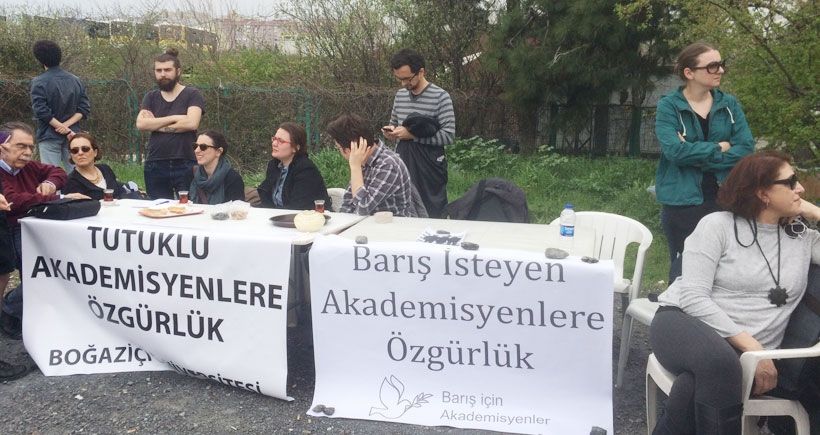
Today, some signatories of the Academics for Peace petition and faculty members from Boğaziçi University were in front of the Bakırköy Prison where their colleague Esra Mungan is held in isolation. The "Freedom Watch" (Özgürlük Nöbeti) will move tomorrow to the front of the Metris Prison where the other two detained Academics for Peace, Muzaffer Kaya ve Kıvanç Ersoy, are being held. According to the daily Evrensel, the Academics for Peace will continue their Freedom Watch in front of prisons until their friends are released.


Tuesday, March 22, 2016


The Responses of the University Administrators to the Recent Arrests and the Suppression of Academic Freedom Are Vastly Different

Rector of Bogazici University visits the Prime Minister 

In a  rare show of public support, Rector of Bogazici University, Prof Gülay Barbarosoğlu and her advisor Prof. Mehmed Özkan met with Prime Minister Davutoğlu for Assist. Prof.  Esra Mungan, one of the signers of the declaration "We Will Not Be Party to This Crime," who has been arrested for alleged terrorist propaganda. Barbarosoğlu had also visited Istanbul Chief Public Prosecutor's Office. Earlier the university senate voted for unconditional support for their colleague and made a press release demanding her immediate release and the protection of academic freedom.

http://www.hurriyet.com.tr
http://www.cumhuriyet.com.tr

Vice Rector of Sabahattin Zaim University Claims Academics for Peace Petition Proves Turkey Must Rely on 'the Acumen of the Uneducated Folk'.

Prof. Bülent Arı: "I trust the acumen of the ignorant and uneducated of this country. I mean, the ones who will sustain and uphold this country are the uneducated, illiterate, ignorant folk. They would never do such mistakes. What to do with that petition, where do I begin? They are dragging Turkey into the fire just like the Young Turks did. The educated groups, starting with the professors ending with the graduates are the most dangerous.  The ones who read the situation most accurately are the elementary school graduates. Because their mind is clear. The university graduates and postgraduates are perilous; they cannot read the trend and their heads are woolly."

'The higher the education level is, the more I get exasperated"

Let's go back to Hamidian Era. Sultan Hamid established institutions of higher education. Replaced the meager education the religious curricula of the medreses offered and spread the secular education all over the country. In other words, it is Sultan Hamid who created the Ottoman enlightenment. Then, those who got educated in these schools overthrew Sultan Hamid. Similarly  here, the higher the education level is, the more I get exasperated. Frankly, I am frightened. I trust the acumen of the ignorant folk. I am observing just like Refik Halit, the most dangerous in everyday traffic are the university graduates. Normally the uneducated people, when you tell them, they obey; they are no treats. The ones who fail to read the world are the educated ones. The more literacy increases in Turkey, the less people have the ability  to analyze the events."
...
http://www.evrensel.net/haber/275541


Faculty Members Association demands the immediate 

release of their colleagues. 


Press Release

Academics Esra Mungan, Muzaffer Kaya ve Kıvanç Ersoy have been arrested for allegedly 

'propagandizing for a terror organization‘; an order for arrest is outstanding for Meral 
Camci. These are signs of a very grave trend: Intellectuals, academics are being investigated, detained, and even arrested simply for expressing their critical views. These 'propaganda for terror' investigations that target intellectuals and lack plausibility are in fact used as weapons to suppress dissident voices. Furthermore, the fact that the whole judicial process takes place under detention transforms them into an unconscionable mechanism of 'punishment with undue process.' 

 In our country, freedom of expression in general, academic freedom of expression in particular are under severe attack. While the political authorities, instead of taking serious precautions to prevent the terror attacks, are pouncing on academics and intellectuals, we sadly keep receiving news of terror and violence every day. We demand the immediate release of our three colleagues, who, we believe, were actually arrested for their dissident views, and all the other intellectuals who were detained or investigated for their writings and words. 

We invite all universities to protect academic freedom most resolutely. We proclaim that we shall defend freedom of expression and academic freedom to the end.

Board of Directors

Faculty Members Association

http://univder.org/basina-ve-kamuoyuna/


Academic Esra Mungan, Arrested Because She Asked for Peace, is Now Placed in a Solitary Confinement Prison Cell


(Translated from an article published in Turkish in Evrensel--accessed on March 21, 2016)

Mithat Fabian SÖZMEN
 İstanbul

Assistant Professor Esra Mungan from Bosphorus University is among the 1128 academics who had signed the declaration, titled “We Will Not Be Party to This Crime.” She is among the three academics who were arrested for signing the declaration. Dr. Mungan was put into solitary confinement in Bakırköy Women’s Prison. By the end of the three-day-long short stay period it was expected that Esra Mungan would be transferred to the ward. The Prison Administration decided that “she is fit to stay in solitary ward.”

'IT IS ALL SEGREGATION CONDITIONS’

Mungan's attorney Meriç Eyüboğlu, said that this decision is definitely unacceptable and that “solitary confinement” means her client is subjected to segregation.

Eyüboğlu noted that Mungan was put into the section reserved for those convicted prisoners with aggravated life imprisonment. “It is all segregation conditions. She has 1,5 hours long right to get fresh air. She is again alone here. She does not meet anybody,” said Eyüboğlu.

OBJECTIONS SUBMITTED

Eyüboğlu noted that it is not clear whether Mungan will be given the right of free visitation once a week, since she is being held in the section where prisoners with right of free visitation once a month are staying. Eyüboğlu said that legal appeals and objections were submitted.

HUMAN RIGHTS VIOLATED

Eyüboğlu noted that the treatment towards Mungan is against law. But beyond that it is against the most basic human rights and that all initiatives at national and international levels will be taken, she added.

ACADEMICS FOR PEACE ARE ALSO STEPPING IN

Eyüboğlu noted that the decision of the prison administration was “inhuman isolation.”  Eyüboğlu also added that ‘Academics for Peace’ are also decisive to initiate all kinds of support and solidarity for not leaving their friends alone.


Sunday, March 20, 2016


Forced Departure of SPIEGEL's Correspondent - latest on a long list of attacks by the government on Turkish and foreign journalists working in Turkey


Spiegel's correspondent Hasnain Kazim
There is an unprecedented escalation in the level of government repression on Turkish media for the last several weeks: the main opposition newspapers have seen their editor-in-chief arrested (CUMHURİYET) or have been seized and brought under direct government control (ZAMAN) or have their press cards cancelled for all their journalist staff (ÖZGÜR GÜNDEM) while the few indepedent TV channels are being forced into submission through cancellation of their critical talk shows (CNNTURK) or cancellation of their satellite broadcasting concessions (IMC TV) or outright seizure of their studios and companies (BUGÜN TV).


Latest in these series of attacks by Turkish government on press freedom is the de facto cancellation of working and residence permits of foreign journalists. In his DER SPIEGEL piece "A Painful Farewell" Hasnain Kazim wrote about the dramatic turn to authoritarian rule in Turkey during his residency and described the circumstances how he has been forced out of the country. In a postscript to the article, SPIEGEL ONLINE editor-in-chief Florian Harms noted: "Based on the behavior of the Turkish government, we can draw no other conclusion than that his journalistic reporting is no longer desired in the country. This behavior toward our correspondent and, thus, also toward SPIEGEL and SPIEGEL ONLINE is, in our opinion, intolerable and also infringes on the freedom of the press. We have decided to withdraw Hasnain Kazim from Istanbul. He will now be based in Vienna. DER SPIEGEL and SPIEGEL ONLINE will obviously continue to report critically, but also fairly on events in Turkey."

Aftenposten's correspondent Silje Rønning Kampesæter


Last month, Middle East Correspondent of AFTENPOSTEN Silje Rønning Kampesæter was declared in effect unwanted and her press accreditation rejected by the government in a move that the Norweigan newspaper described as "being thrown out of Turkey" - a first since the long-established paper's journalist was declared non-grata in 1971 in the Soviet Union.

In September 2015, Dutch independent journalist Frederike Geerdink was first detained for three days then expelled from Turkey after she lived in and reported from Istanbul and Diyarbakir since 2006.


Academics for Peace: The Court's Arrest Decision

Three academics who signed the "Peace Petition" are in prison under the allegation that they conducted terrorism propaganda. In our March 18, 2016 blog entry, we have exposed a conspiracy-theory-like article published in a pro-government website that the Istanbul Prosecutor's Office has taken as a criminal complaint, which eventually led to the arrest of Muzaffer Kaya (Nisantasi University--terminated for having signed the Peace Petition), Esra Mungan (Bogazici University) and Kıvanç Ersoy (Mimar Sinan University). A closer look at the court's decision to arrest the academics suffices to show how the court appears to have taken this decision because the academics did not criticize PKK in the "Peace Petition" and called their government for accountability on the escalating violence instead.

The court decision asserts that the Turkish "state acts in self-defense when it undertakes operations to end armed attacks by terrorists [...]. To describe these operations as 'massacres' while making no mention of the terrorists who are in fact responsible for the violence is evidence that the signatories share the views and support the actions of the terrorist organization. The court concludes that the petition must be understood in this light as a form of support for terrorist activities. As a consequence, there is substantial evidence that the suspects committed the crime of which they are accused." 

Apparently, according to the court, the fact that the ruling party AKP (together with the Turkish nationalist party MHP) blocked a parliamentary investigation of the ISIS-led suicide bombing in Suruc on July 20, 2015, and that instead of conducting an investigation, it chose to bomb PKK camps--and thus unilaterally ending the peace process, is not reason enough to call AKP for accountability. Neither does it seem to matter that had the AKP not block the investigation, perhaps the bloody Ankara bombing in October 2015 (that resulted in the loss of 102 lives) might have been prevented. The October Ankara bombing was apparently instigated by the same ISIS cell as the Suruc bombing. The bombing target there was a Peace Rally in Ankara asking for a return to the peace negotiations. Further, it also doesn't seem to matter that such state policies should be accounted for, especially considering the images that demonstrate the scale of destruction as a result of what the court calls a self-defense, in addition to the loss of lives of civilians and kids.

The Arrest Decision Ruled by the Court

Overall, as the Human Rights Watch has noted, the fact of the matter is that three academics are in prison for having signed a petition calling their government for accountability, for maintaining a critical stance against their government's Kurdish policies and asking for peace.

Academics for Peace--The Arrest Decision Ordered by the Court in English Translation:

1. Concerning the allegations against suspects Muzaffer Kaya, Esra Mungan and Kıvanç Ersoy of committing the crime of Engaging in Propaganda for a Terrorist Organization: a request has been submitted for the detention of each of the suspects. According to the investigative file in this case, following the shooting of two police officers in the back by the PKK terrorist organization on 22 July 2015, in the town of Ceylanpınar in the province of Şanlıurfa, the PKK increased its activities and attacks. To facilitate the continuation of its activities, the PKK has blocked security services’ access to whole neighborhoods by digging trenches at the entrance of neighborhoods and streets and building barricades; terrorists have attacked security forces with rocket launchers and automatic rifles; and PKK affiliates have proclaimed different localities to be self-governing on different dates. In this context, BESE HOZAT, a co-chair of the executive committee of the PKK/KCK terrorist organization issued a public call through the media that “Enlightened and democratic circles should support these self-governments.” Following this declaration, security services’ access to those areas that had been declared so-called “self-governments” was blocked by the building of barricades, the digging of trenches and booby-trapping the streets with explosives. In its effort to re-establish security in these zones, the government imposed a curfew and initiated military operations. During these operations a large number of members of terrorist organizations were eliminated, barricades were removed, trenches were covered, large numbers of explosives were disposed of, and large numbers of guns and munitions were seized. While these operations were ongoing, on 11 January 2016, “1128” persons, including the suspects, published a statement under the heading “We will not be party to this crime!” The statement included the following claims: “The Turkish state has effectively condemned its citizens in Sur, Silvan, Nusaybin, Cizre, Silopi, and many other towns and neighborhoods in the Kurdish provinces to hunger through its use of curfews that have been ongoing for weeks. It has attacked these settlements with heavy weapons and equipment that would only be mobilized in wartime. As a result, the right to life, liberty, and security, and in particular the prohibition of torture and ill-treatment protected by the constitution and international conventions have been violated. Describing the commission of deliberate and planned massacre … the adoption of policies of massacre and deliberate deportation, the commission by the state against its own citizens of violence and massacre, as academics and researchers we will not be a party to this massacre.” This statement constitutes support for the PKK terrorist organization and its timing suggests that it was undertaken in parallel to PKK member Bese Hozat’s public demand [for support of self-governments]. The PKK’s continuing armed attacks, which were the cause of the violence in this period, were a matter of public record yet the statement does not mention, criticize or condemn the PKK, a fact that underscores the degree to which this statement appears designed to support the activities of the terrorist organization. After the publication of the statement, the suspects convened a press conference to read aloud the text again and use the media to repeat the claims in the statement, which under the pretext of supposedly calling for peace was in fact a form of propaganda for a terrorist organization. Following this statement, all terrorist organizations and the PKK terrorist organization have continued their activities, accelerating assaults against the lives and property of all citizens without regard to whether their targets are soldiers, police officers or civilians. These attacks represent a grave threat to peace and security in the country. However much the suspects and their supporters defend the statement under the rubric of freedom of expression, it is clear that similar activities are addressed through counter-terrorism measures in Europe. European states have responded to similar terrorist threats by taking all necessary measures against those who commit attacks and anyone that has the slightest relationship to such attackers including armed operations against terrorists and those affiliated with terrorists until such individuals are neutralized. The state’s most basic obligation is to protect the rights of life and security for all of its citizens. The state is acting in self-defense when it undertakes operations to end armed attacks by terrorists who threaten these rights. To describe these operations as “massacres” while making no mention of the terrorists who are in fact responsible for the violence is evidence that the signatories share the views and support the actions of the terrorist organization. The court concludes that the petition must be understood in this light as a form of support for terrorist activities. As a consequence, there is substantial evidence that the suspects committed the crime of which they are accused. In light of the importance and seriousness of the alleged crime, the minimum and maximum punishment prescribed by law, the absence of any grounds precluding arrest or trial under Article 100 et seq. of the Turkish Criminal Code, and the risk that the suspects might try to escape in light of the seriousness of the punishment they face, and giving due consideration to principles of “proportionality,” the suspects are ordered arrested on the grounds that the investigation is continuing and that the suspects represent a flight risk.

The court orders that: The suspects Muzaffer Kaya, Esra Mungan, and Kıvanç Ersoy be arrested in keeping with Article 100 et seq. of the Turkish Criminal Code on suspicion of Engaging in Propaganda on behalf of a Terrorist Organization.