Thursday, June 20, 2013

Letter of Complaint Regarding Hate Speech and Racist Behavior by Ahmet Atan, Yildiz Technical University, Chair of the Arts Department*

Dear Madam/Sir, 

We are writing to report the unacceptable racist behavior shown by Ahmet Atan,** who, according to his own website, is the president of the Turkey chapter of the World’s Academy of Arts “New Era.”  We are a group of academics and scientists in the United States who research, work, and critically engage with issues regarding  freedom of academic and journalistic research in Turkey and the liberties of association and publishing thereof. 

On June 16, 2013, Mr. Atan sent three tweets via his twitter account, of which a screen capture has been taken.
In the third tweet, which he proceeded to delete later on, he states: 

"If you are Jewish, Armenian or Greek, I would understand your active participation in the Gezi Park protests. Please research your racial genealogy."

According to another website, http://dunyasanatlarakademisiturkiye.blogspot.de/, it appears that, besides representing your academy in Turkey, Mr. Atan was also awarded the "Artist of the Year 2013" by your institution.

Please pursue this case as you see fit. We also kindly request that you keep us informed of your actions regarding the racist comments of your member and conferee. We are hoping that the World’s Academy of Arts “New Era,” in accordance with its Statute of Titles 4.3, in case "an Academy’s conferee commits an act (or shows inaction) that discredits the Academy’s reputation," will denounce this kind of behavior, and make a public declaration of Mr. Atan’s exclusion from membership.

We are looking forward to hearing from you on this matter by July 01, 2013. In case the deadline passes with no veritable action on your part, we feel that it is our responsibility to inform the Jewish, Armenian and Greek communities in Turkey and other Art Academies globally about Mr. Atan's unacceptable behavior and your condoning inaction hereto.


Thank you in advance for your inquiries in this matter. Kind regards,


GIT- North America, 
Transnational Work Group on Academic Liberty and Freedom of Research in Turkey
http://gitamerica.blogspot.com/


*GIT-NA would like to thank friends who have brought this matter into our attention. We have sent an electronic mail with the above content to the World’s Academy of Arts “New Era," and we urge our readers to follow suit. They can be reached at info@artnewera.com
**There is also an important petition calling for Ahmet Atan's disposition from the faculty.

Wednesday, June 5, 2013

Listening to Taksim

As resistance to the unprecedented police violence unleashed by Erdogan’s government against the rights of peaceful assembly and freedom of expression continues in Turkey, the original scale of the resistance movement that crystallized into being on May 31, 2013 has mushroomed in lightning speed. What began as the protection struggle of Gezi Park in Taksim Square has now evolved into demonstrations of solidarity in several squares and streets of Istanbul, Ankara, Izmir and other provinces.

One uniting feature of these public demonstrations is their inclusiveness of multiple currents of opposition to PM Tayyip Erdogan’s rule. Yet the roots and forms of Taksim revolt are both complex and evolving. As GIT North America newsfeeds resume, we present analytical snapshots taken by members of GIT – NA working group regarding this historically novel stage of resistance to ruling party AKP’s suppression of freedoms of expression.

Gülay Türkmen-Dervişoğlu traces the moment of formation of resistance at Gezi Park and the coalition behind the protest in Open Democracy. Evren Savcı highlights the social context of opposition to AKP’s neoliberal policies in Jadaliyya. The focus of Umut Özge’s critical contribution to Open Democracy is the simplistic templates often used in mainstream media to understand the emerging resistance in Turkey

In a stark contrast to the censorship prevalent in Turkish TV during the first days of the protests and truncated images of civil unrest in international media, Ariel Salzmann conveys the diversity of Taksim revolt and its emerging contribution to an expansion of civil discourse in her live interview at Canadian main news network CTV News. Similarly, Ayça Çubukçu underscores the promise of Taksim as an experimentation with direct democracy in an interview toward the end of a BBC Two news report (provided as a Youtube link here to facilitate global access).


If one aim of GIT – NA is to produce and give an overview of critical research regarding repression of freedom of thought, another aim is to listen to the voices of resistance to this repression and to bear witness as the starting point of research. These voices are indeed multiple. For a glimpse into their multiplicity and coherence you can read the statement that Taksim Solidarity, the umbrella group of numerous rights and political organizations, issued to the public and presented to the government on June 5.

Monday, June 3, 2013

GIT-North America Condemns Police Brutality in Ongoing Nationwide Rallies in Turkey

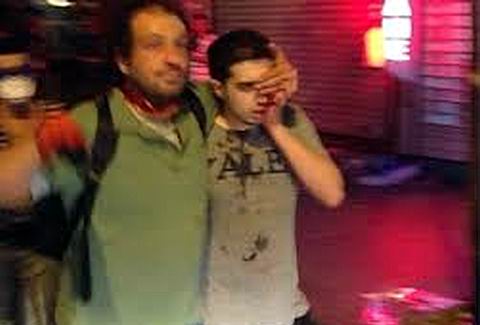
Dr. Burak Ünveren, a member of Department of Economics at Yıldız Teknik University and Selim Gören, a student of the same department lost one of their eyes after being shut by a tear gas canister fired by the Turkish riot police. Burak and Selim are among many, who were seriously injured by tear gas and water cannons directed against protestors in the ongoing anti-government rallies in Turkey. The protests began as a reaction to governments plans to demolish Gezi Park, one of the last green spaces in central Istanbul and replace it with a shopping mall, a replica of Ottoman era artillery. The brutal crackdown of protestors last week inflamed nationwide rallies over the weekend against police brutality and anti-democratic rule of the government. You can read more on Burak and Selim's cases in Turkish here and more on the protests here.


Dr. Burak Ünveren

Saturday, April 27, 2013

The Day that Academic Liberty Sank in Gallipoli

(This post is GIT - North America's translation of the news piece published in the daily Radikal on 04/22/2013. More, in Turkish, can be found here and here. Her statement, also in Turkish, can be read here.)

Mukaddes Akdeniz had, for a while, been teaching "Life Skills and Social Activities" at Tekirdag Namik Kemal University's Department of Chemistry. Two years ago, on December 30, 2011, when a student, M.C., during a presentation on the Battle of Gallipoli, claimed that "the imams and saints won the battle with their frocks," Akdeniz objected to this claim on the basis that "it is not scientific." Another student gave a presentation on [the renowned Ottoman Empire architect] Mimar Sinan. Yet another student, during his/her presentation on the history of Tekirdag, said that the Armenian, Greek-Orthodox and Jewish populations of the city were all gone now. Following this presentation Akdeniz lamented that "we could not protect our cultural heritage" and recounted the story of a friend of hers who, after denigrating Armenians for years, had found out during his/her grandmother's funeral that she was actually of Armenian descent. The class ended thus; and yet, the "trial" of Akdeniz was only beginning. 

M.C., who had presented on the Battle of Gallipoli, submitted a letter to the Dean on January 4, 2012, with the complaint that he/she had received a failing grade. According to M.C., Akdeniz had stated that there "is no other battle as nonsensical as the Gallipoli," had defended the Armenians and imposed her own views on the class. "Me and the rest of the class, we all learned that day that our teacher's family is of Armenian origin" said M.C. Another student, E.G., claimed that "these comments were belittling the Battle of Gallipoli, a source of pride for our nation, and were detrimental to the unity of the nation." A.K., another student of Akdeniz's said: "I find it disturbing that, in class, she imposes on us feminism and topics of political content."

On April 9th, Akdeniz encountered in the papers the news that she had allegedly insulted Gallipoli veterans, and had stated: "Do not fool yourselves with this rubbish. The real war is Kurdish people's war for independence." Following these, Tekirdag Anti-Terrorism Bureau heard the testimony of twelve students. The students claimed that Akdeniz had maintained "Armenians were the first to offer help following the earthquake in Van," and that she was "teary-eyed when talking about her friend's relationship to her Armenian identity, as if she was talking about herself." However, they reported that she had not stated "The real war is Kurdish people's war for independence," and that she might have rather said "The real issue is our struggle for independence." All of the students spoke of how "she had not engaged in any propaganda about any political ideology or terrorist organization" but that she had mentioned "the poor administration by the government, lack of justice, women's oppression and income inequality."

Regardless, the police report claims that Akdeniz had used the term “worthless” in regards to the Battle of Gallipoli, that she had stated “I am from the city of Kars, but I am of Armenian descent,” had praised the student presentation on Mimar Sinan by saying “Thank you for preparing slides that illustrate the problems of Armenians,” and had stated “Not only Turkish people live in this country, Armenians and Kurds live here, too. You cannot ignore them.” As a result, the report claimed that Akdeniz “might incite animosity and hostility by engaging in propaganda against the State, and could thus endanger public safety by igniting potential conflict.” In addition, the report asserted that she had spread PKK propaganda via the expression “The real issue is our struggle for independence.” The police report also stated that Akdeniz is being investigated for allegedly spreading PKK propaganda because she had attended the Nevruz celebrations in the city of Çorlu in 2010. Her case has been sent to Istanbul Public Prosecutor's office in charge of TMK (Turkish Civil Code) 10. 

The Office of the President of Namık Kemal University took action in accordance with the police. They started an investigation claiming that [Akdeniz] “strayed away from the syllabus, and expressed personal statements disparaging the state, derogating national and moral values and aiming to promote certain ethic groups” and that [she] “forged attendance sheets for the three weeks that she was absent.” According to the claims [of the university], she had rescheduled one class, the following week she could not make it due to the news of her parents’ cancer, and the week after that she returned to find an empty class. However, it is said, she collected course payments as usual. The Office of the President concluded their investigation with the suggestion that she be laid off, claiming that she “had unaccounted extra income.” The judicial clerk for the Disciplinary Committee of the Board of Higher Education, Beril Dedeoğlu, in her statement dated 28 February 2003, suggested that the punishment should be approved, but, that due to Akdeniz's good standing, it should be deemed as “supposition of retirement from office.” The Board of Higher Education affirmed this claim and dismissed Akdeniz from profession.

Sunday, January 27, 2013

MESA urges Turkey to Take Action Against Anti-Democratic Activities of Marmara University Dean

In a letter "[...] concerning the alarming incidents that have been reported at Marmara University’s Faculty of Communications under the leadership of its government-appointed dean, Yusuf Devran," the Committee on Academic Freedom of the Middle East Studies Association of North America (MESA) urged Prime Minister Tayyip Erdoğan to take action:

"Since his appointment in July 2011, Dean Devran has reportedly used his position to single out students and faculty for surveillance, verbal and physical harassment, disciplinary proceedings and ethnic and political profiling—including the designation of students as potential PKK affiliates as a result of their involvement in activities deemed critical of the government or of the dean himself, or simply because they are ethnically Kurdish. Beyond the targeting of students and faculty, he has also used his position to cancel academic programs on the basis of objections to their substantive focus in a manner inimical to academic freedom.
[...]
The case of the events at the Faculty of Communications at Marmara University since Devran’s appointment as dean by YÖK offers the most troubling and intensive example of violations of academic freedom that are becoming unfortunately common on university campuses across the country."

The letter was published in the independent ezine Jadaliyya. Amnesty International – USA’s Turkey Regional Action Network published a piece on the letter, which provides links to similar cases.

Thursday, January 24, 2013

Pınar Selek: Sentenced, again.


The case of Pınar Selek, a Ph.D. candidate in Political Science at Strasbourg, and the "released again - sentenced again" cycle of shame continues. In a previous post, we had discussed the absurdity of this case and how despite the lack of any concrete evidence, Selek trials continued. A website dedicated to Selek also contains information on the case.

The Amnesty International coverage by Howard Eissenstat today states that:

"Turkish press sources report that Pinar Selek was today found guilty and sentenced to
life imprisonment in the 1998 bombing of the Egyptian Bazaar. As we noted earlier this 
week, Selek had three times been acquitted on these same charges and there have been
on-going concerns with the weakness of the evidence in the case."

To read more from the Amnesty International, you can click here and here.

Also, for a recent MESA Committee on Academic Freedom letter on the subject--demanding justice for Selek, please click here. The letter summarizes part of her plight as follows:

"Selek was charged with membership in the PKK (Partiya Karkerên Kurdistan- Kurdistan Workers’ Party) on the basis of extremely weak evidence allegedly linking her to an explosion at the Istanbul Spice Market in 1998. The sole basis for this allegation was the testimony of a single individual who retracted his statement in open court and asserted that it had been extracted under torture. Further, multiple expert reports have challenged the claim that the explosion in question was even caused by a bomb. When Selek was first taken into custody she was conducting research on the PKK and during the two years of her detention she herself was subjected to torture by interrogators who demanded that she reveal the names of her interview subjects. Indeed, all of the circumstances attendant to her case suggest that Selek has been on trial for the last fourteen years for her research on the PKK in violation of her right to academic freedom."

Selek was interviewed on CNN Turkey, and announced that she will hold a press conference tomorrow, January 25th, at noon.

As students and professors working in diverse fields, including Ottoman and Turkish Studies in North America, we are profoundly distressed by Selek’s treatment and we stand in solidarity with her academic rights to peacefully conduct research and her individual right to a just closure to this case.


Friday, January 18, 2013

For Hrant Dink – 6 years have passed!

It has been six years since Hrant  was murdered and one year since the trial (charade) ended. None of the state officials implicated in his murder have been investigated in any satisfactory manner. Not only have they not been brought into justice, almost everyone whose name is connected with this murder has been promoted. One of those who convicted him for something he did not write became the ombudsman of the Turkish Republic.  His murder was a brutality, things happening since the murder are an infamy,  and they are shameful. The struggle for justice continues on the sixth anniversary of Hrant Dink’s assassination.

Here is a link to the short documentary filmmaker Ümit Kıvanç has prepared to mark the sixth year.

The headlines in the documentary as translated by GIT North America are as follows:

For Hrant! We’re Here Ahparig (dear brother)!

They jailed the kid they used to kill you.
But they first made him a hero.

And they sacrificed a man to be punished,
the one they chose among those they had trained.

One of the murderers was their official employee,
to punish him would be too much, so they spared him.

They rewarded everyone who either participated  
or were an accomplice to the murder.

They promoted them, appointed one a governor,
took in another one to the Parliament.

The judge who made you a target – he prospered.

They got angry when we called them murderers.
But all of them are rewarded in high offices of the State.

This is what it must be like
to sink as you move higher.

They are sinking into the swamp
in their business suits.

This is what it means to be low.

To contradict those who have no shame
We’ll be there that day, ahparig!

On January 19, on the pavement they shot you
We’ll be here, ahparig!

The cases of Prof. Dr. Fatih Hilmioğlu and Prof. Dr. Mehmet Haberal


Below is a detailed account of the cases of Prof. Fatih Hilmioglu and Prof. Mehmet Haberal. We believe in their right to a prompt fair trial regardless of their politics.

Prof. Dr. Fatih Hilmioğlu is a physician and a professor of medicine and was a faculty member at Başkent University in Ankara, Turkey and former rector of İnönü University in Malatya, Turkey. He was arrested in April of 2009 under the over sweeping Ergenekon investigation and has been imprisoned for over 3 years. Dr. Hilmioglu is accused of being part of the alleged Ergenekon criminal organization working towards destabilizing the country for overthrowing the elected government, an organization whose existence is yet to be proved (Abbott, 2012). While awaiting trial, Dr. Hilmioğlu has suffered from cirrhosis of the liver. Despite the recommendation that he should be released to await trial as he received medical treatment as “he has the risk of liver cancer, and staying in prison means his life could be in danger” (Gürdoğan, 2010), he was sent back to Silivri prison. As predicted by the medical professionals who treated him, his health has taken a turn for the worse. Dr. Hilmioğlu has been diagnosed with liver cancer and is gravely ill. Members of several civil society organizations including Turkish Medical Association (Turk Tabipler Birligi), Association of Academic Staff (TÜMÖD), Social Democracy Foundation (SODEV), and journalists have come together in early January of 2013 to issue a press release to request the release of Dr. Hilmioğlu (Cumhuriyet, 2013).
            
 Prof. Dr. Mehmet Haberal is also a physician and a professor of medicine.  He is a pioneer of transplant surgery in Turkey, founder of 10 hospitals, 6 dialysis centers, and the founder and former rector of Başkent University in Ankara. (Biography and publications can be seen from his website). He also has been imprisoned for over 3 years accused of being affiliated with the alleged Ergenekon criminal organization. He had transformed the court transcript of his first verbal deposition and cross-examination which had taken place after a year after his arrest in a book titled “What is my Crime? (Akyol, 2011). Dr. Haberal is 69 years old and suffered from heart disease in jail.
  
The excessive length of criminal proceedings in Turkey has been well documented in several national and international reports including the 2012 Turkey Progress Report of the European Union, the Reporters without Borders Investigation Report, Human Rights Watch, and the U.S. State Department’s Human Rights report. The Committee of Concerned Scientists (CCS), an independent organization of scientists, physicians, engineers, and scholars devoted to the protection and advancement of human rights and scientific freedom, sponsored a petition on their website (concernedscientists.org) calling for the release of Dr. Fatih Hilmioglu and Dr. Mehmet Haberal, for health reasons pending the outcome of their trials. The petition states: 

In October of 2009, CCS wrote in concern about Drs. Mehmet Haberal and 11 other doctors and academics under indictment in Turkey. CCS has learned that most of the arrested academics have been released on bail. However, two of those on our list are still being held: Dr. Mehmet Haberal, the rector of Baskent University in Ankara, who pioneered transplant surgery in Turkey, and Dr. Fatih Hilmioglu, a gastroenterologist, former rector of Inonu University in Malatya. CCS urges the release of Drs. Haberal and Hilmioglu for health reasons pending the outcome of their trial.
The two have now been detained for almost three years. Turkish law allows indicted individuals to be kept in long-term detention only if there is a danger that they might either destroy evidence or flee - not likely in this case. Drs. Haberal and Hilmioglu have been in state custody since their arrests in April 2009; however, because both were suffering from ill-health, they were held in hospitals where they reportedly were receiving medical attention. Both men were subsequently transferred back to prison. Since then, their health reportedly took a turn for the worse. Dr. Hilmioglu suffers from cirrhosis of the liver and reportedly is gravely ill. Dr. Haberal has angina, cardiac arrhythmia, and severe anxiety and depression.
CCS is concerned that these academics and doctors appear to be on trial solely for peacefully exercising their rights to freedom of expression and of association. CCS is also concerned that such extensive detention without bail deprives defendants of their rights under Turkish and international law, which require such a trial to be held within a reasonable time. Finally, almost three years in detention pending trial, especially under these circumstances, surely exceed any limitations in the Turkish constitution and the European Convention on Human Rights.”

You can view and sign the petition for the release of Drs. Haberal and Hilmioglu, on the CCS website at: http://concernedscientists.org/2011/11/petition-for-the-release-of-drs-haberal-and-hilmioglu-from-prison-in-turkey/

Sources:
Abbott, Alison. (June 26, 2012) Secularist academic jailed in Turkey. Nature, available at: http://www.nature.com/news/secularist-academic-jailed-in-turkey-1.10891 [accessed January 8, 2013]

Akyol, Mete. (Eds.). (2011). What is my crime? Professor Mehmet Haberal’s oral Silivri deposition. Ankara, Turkey: Can Matematik Yayınları.Available at: http://www.mehmethaberal.com.tr/en/what_is_my_crime.pdf

Cumhuriyet (January 8, 2013). Fatih Hilmioğlu'na özgürlük çağrısı, available at:

European Commission (December 10, 2012) Turkey 2012 Progress Report Accompanying The Communication From The Commission to the European Parliament and the Council, Enlargement Strategy and Main Challenges 2012-2013, available at: http://Ec.Europa.Eu/Enlargement/Pdf/Key_Documents/2012/Package/Tr_Rapport_2012_En.Pdf  [accessed January 8, 2013]

Gurdogan, Burhan. (August 13, 2010) Turkey’s Ergenekon investigation - violations and inconsistencies. OpenDemocracy, available at:  http://www.opendemocracy.net/burhan-gurdogan/turkey%E2%80%99s-ergenekon-investigation-violations-and-inconsistencies [accessed January 8, 2013]

Human Rights Watch.  (November 1, 2010).  Protesting as a Terrorist Offense: The Arbitrary Use of Terrorism Laws to Prosecute and Incarcerate Demonstrators in Turkey, available at: http://www.unhcr.org/refworld/docid/4cd2b8b02.html [accessed January 8, 2013]

Reporters without borders. (RWB). (June 2011). Media and Justice in Turkey, Mistrust And Repression Investigation Report, available at: http://en.rsf.org/IMG/pdf/rsf_report_turkey_2011_en.pdf [accessed January 8, 2013]

U.S. Department of State (2011). Bureau of Democracy, Human Rights and Labor
Country Reports on Human Rights Practices for 2011: Turkey, available at: http://www.state.gov/j/drl/rls/hrrpt/humanrightsreport/index.htm?dlid=186414 [accessed January 8, 2013]

Thursday, January 3, 2013

394 Signed Our Statement of Solidarity with METU


As scholars and students from Turkey as well as academics working on Turkey and the Ottoman Empire in North America we are deeply concerned by the recent incidents that took place at the Middle East Technical University (METU) campus on December 18, 2012 during and after Prime Minister Erdogan's visit.

Security forces used excessive force and violence against students protesting peacefully, some of whom were arrested and held in detention. Following the incident, in response to the campus-wide boycott initiated by the faculty and students, the PM made public statements which insulted and threatened the university's faculty. Both police actions and the PM's verbal assaults constitute a direct assault on the university as an institution, its educational role in society, and on freedom of thought. Attempts to label every act of dissent and criticism of the ruling party as "terrorism" must be condemned, particularly when they might influence current policy decisions. That these events took place at a time when a revision of the bill for The Council of Higher Education (YOK, the central governing body for all post-secondary institutions) is under discussion, is very disconcerting.

The METU incident is only one of increasing number of direct assaults on university students and faculty members that leave us gravely concerned for the present and the future of democracy in Turkey. The authoritarian tendencies in the ruling party and the use of both police violence and judicial repression are growing daily. They pose severe impediments to freedom of thought and expression in every domain. We take this opportunity to express our solidarity with academic institutions, faculty members and students in Turkey who face this repression.


Please find the signatories to our statement here.


You can read our statement in Turkish here

From Prison: A letter from Kemal Gürüz


A letter from Professor Kemal Gürüz, the former president of Turkey's Council of Higher Education (YÖK) and a retired chemical engineer, who was arrested on 25 June 2012 in relation to '28 February Investigation.' He has been in pre-trial detention for over six months in a maximum-security prison in Turkey. Although we do not endorse his political position and many of his past activities as the president of YÖK, we believe in his right to a prompt fair trial.

As in his first letter, in this second letter Gürüz responds to accusations concerning his involvement in the 28 February Process, which led to the resignation of the government in 1997, following a series of ultimatums from the military to end political activities considered threatening to the country’s constitutional secularism. 


19 Thousand and 507 Websites Blocked in 6 Years


published in Milliyet daily, translated by GIT North America

The book entitled “10 Years of Freedom of Speech,” and published by IPS Foundation of Communications/Bianet, evaluates Turkey’s freedom of speech. 
The book was co-edited by Emek Çaylı ve Gülsüm Depeli and includes contributions by Fikret İlkiz and Reporters without Borders’ Turkey Chapter representative Erol Önderoğlu. Bullet points from the book include the following:
-        At least 489 media workers and at least 64 media organizations were attacked over the last 10 years. Most of these attacks were physical. At least 553 assaults against media workers and organizations were recorded in that time period.
-        3 journalists were murdered: İlyas Aktaş (reporter for the journal Revolutionary Democracy) in 2006, Hrant Dink (editor-in-chief of the bilingual Turkish-Armenian newspaper Agos) in 2007, and Cihan Hayırsever (representative of the television channel Marmara) in 2009.
-        Having issued bans on broadcasting to various organizations amounting to a total of 2 thousand and 921 days in 2002 alone, RTÜK (Radio and Television Supreme Council) shut down 29 radio stations and television channels for a total of 870 days in 2003, 2004 and 2005.
-        20 national television channels had to file defense statements, 33 channels were given warnings, and 9 were obliged to cease broadcasting programs in 2005. Television channel Kanaltürk was penalized with program bans 6 times in 2007 because of the way they broadcasted electoral politics. RTÜK issued a total of 2 thousand and 22 warnings, 262 bans on programs, and 1 decertification of broadcasting from May 2002 until the end of 2008. Throughout the year 2011, RTÜK issued 89 penalty fines to 20 radio stations and 480 TV channels, 383 warnings, 27 bans on programs, and one official notice.

Prime minister opened 4 law suits
-        According to the report  43, one thousand and 46, 6 thousand and 131, 7 thousand and 762, 14 thousand and 737, 19 thousand and 507 sites were blocked in 2007, 2008, 2009, 2010, 2011, and 2012 respectively as part of the “internet bans.”
-        At least 167 journalists were detained. Among the reasons for their detentions some stood out: “conducting interviews with members of illegal organizations,” “propagating terrorism by publicizing views of the leader of an illegal organization,” and “affiliation with an illegal organization.”
-        Prime Minister opened 4 law suits against media outlets in 2004. He lost 3 of the 6 law suits that he filed against the newspapers Cumhuriyet and Sabah, journal Leman and TV channel Kanaltürk. 7 of the 49 law suits for libel and attack on personal rights that were filed against media professionals were filed by the Prime Minister.
-        Since 2005 approximately 40 official investigations were launched against the [humorous] website Ekşi Sözlük, 5 percent of which were turned into law suits.

5 Other Countries Likewise Censor
Some of the countries with the strictest internet bans are:
Syria: Majority of the bans over the use of internet have “political” justifications. Entering the banned sites is punished by imprisonment.
China: The internet filters that are in place comprise pornography, as well as issues such as police brutality, and the independence of Taiwan and Tibet. The filters apply not only to domestic news outlets but also to international ones.
Iran: The internet is fully controlled by the state. Those who breach the censors are sentenced to prison.
Russia: Capital Moscow is under extensive surveillance.
France: The government of Paris controls the users of internet.